




Claim:
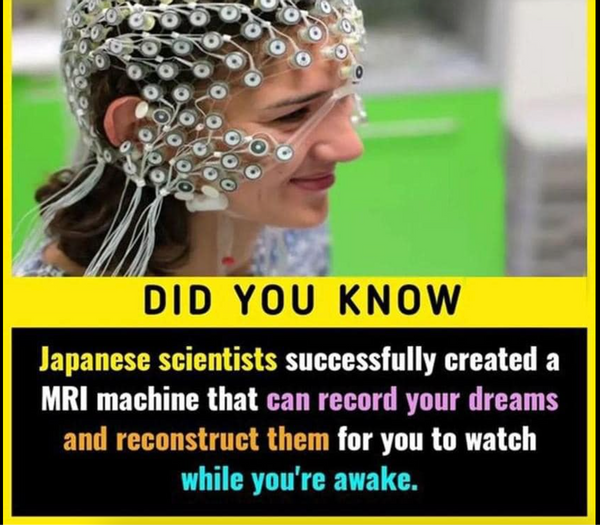
Japanese scientists successfully created an MRI machine capable of recording dreams and replaying them later like a video.
Rating:
Mixture
What’s True
In 2013, Japanese researchers published a study using functional magnetic resonance imaging (fMRI) and machine learning to analyze brain activity associated with dreaming.
The researchers were able to identify patterns linked to certain visual objects seen in dreams and generate rough visual reconstructions based on that brain activity.
The experiment represented a significant advance in decoding visual experiences during sleep.
What’s False
The technology did not “record dreams” in the way social media posts often suggest.
Scientists did not create a machine capable of capturing full dream movies or replaying dreams exactly as a person experienced them.
Instead, the system generated sequences of simple reconstructed images associated with specific brain activity patterns — not detailed cinematic recordings of entire dreams.
The claim gained attention again in recent years after social media posts suggested Japanese researchers had invented an MRI machine capable of recording dreams “like a movie.”
The story was based on a real scientific study published in 2013 by researchers in Japan.
Using functional MRI scans and machine learning models, scientists attempted to decode visual elements appearing in subjects’ dreams.
The research attracted global media coverage at the time because it represented one of the first successful attempts to partially reconstruct dream-related imagery from brain activity.
However, many online posts exaggerated what the technology actually achieved.
What Wiseman actually described
Wiseman’s remarks focused on the emotional impact of returning from space and trying to process the experience.
He explained that the mission left him overwhelmed and emotional after returning to Earth.
The comments were personal reflections about awe, emotion, and human experience — not a public declaration of religious conversion.
Another Artemis II crew member, pilot Victor Glover, also clarified during the discussion that the astronauts were describing feelings of wonder and perspective rather than announcing changes in faith.
Why the viral posts are misleading
Many social media posts exaggerated Wiseman’s comments by turning an emotional moment into a conversion story.
Some posts incorrectly assumed that because Wiseman said he was “not really religious,” he must have been an atheist before the mission.
Others falsely paraphrased his words into stronger religious statements that he never actually made.
Additionally, some posts misleadingly implied Wiseman landed on the moon.
In reality, Artemis II was a lunar flyby mission, not a moon landing mission. NASA described the mission as a multi-day journey around the moon before returning to Earth.
Reid Wiseman did not publicly announce that he converted to Christianity after the Artemis II mission.
He described an emotional interaction with a Navy chaplain after returning to Earth, but his remarks did not amount to a declaration of religious conversion.
Clarifact therefore rates the claim as False.
Sources:
- Calaprice, Alice. The Ultimate Quotable Einstein. Princeton: Princeton University Press, 2010. ISBN 9781400835966.
- Emerson, DeAnna. Mars/Earth Enigma: A Sacred Message to Mankind. Lakeville, MN: Galde Press, 1996. ISBN 9781880090183 (p. 103).
- Mount, Harry. “Was Einstein Right?” Daily Mail. 27 January 2015.
- IMDb.com. “Powder.” Accessed 6 March 2017.
- Wikiquote. “Powder (film).” 1 August 2014.

