


Claim:
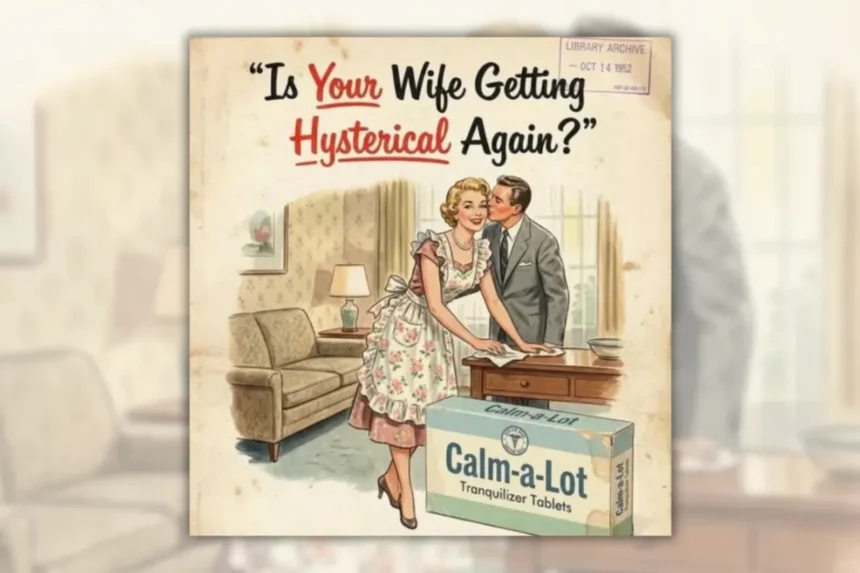
An image authentically shows a 1952 advertisement for “Calm-a-Lot” tranquilizer tablets featuring the slogan: “Is Your Wife Getting Hysterical Again?”
Rating:

Fake
A supposedly vintage advertisement circulated widely on social media in early 2026, claiming to show a sexist 1950s ad promoting tranquilizer tablets called “Calm-a-Lot.”
The image featured retro-style artwork of a smiling housewife alongside text suggesting the medication could calm women upset by “household worries” and everyday stress.
Because many genuinely sexist advertisements existed during the 1950s, some viewers assumed the image was authentic.
However, available evidence strongly suggests the advertisement was digitally fabricated.
What We Found
The 50s were wild! That being said, I know a lot of husbands who would give this to their wives 🤣 pic.twitter.com/GlMazja1w1
— Dr. Clown, PhD (@DrClownPhD) February 10, 2026
Researchers were unable to locate any historical evidence showing that a product called “Calm-a-Lot” ever existed.
Searches across:
- Bing
- DuckDuckGo
- Yahoo
- Newspaper archives
- Medication databases
produced no credible records of the product.
The advertisement also claimed the product had appeared in Life magazine, but searches through archived Life magazine issues did not uncover the ad.
A review of the October 1952 edition referenced in the image similarly showed no trace of the supposed advertisement.
The product itself appears fictional
The ad described Calm-a-Lot as a tranquilizer or anti-anxiety medication intended for homemakers dealing with stress.
However, medical databases and drug archives contain no evidence that a medication by that name was ever manufactured or sold.
Even extensive searches through discontinued pharmaceutical listings failed to identify any such product.
Signs the image was digitally created
Reverse image searches found only modern social media posts sharing the image rather than authentic historical records.
The image also included details commonly seen in fabricated “retro” graphics online, including:
- Artificial aging effects
- Fake archive stamps
- Exaggerated stereotypical language
While the design intentionally mimicked authentic advertising styles from the 1950s, no verifiable source confirmed it originated from that era.
Why people believed it
Advertisements from the mid-20th century often contained sexist messaging that would be considered offensive today.
Because of that historical context, the fake Calm-a-Lot ad appeared believable to many viewers at first glance.
However, despite resembling genuine vintage advertising, this particular image does not appear in historical archives and lacks any evidence of real publication.
The Bottom Line
Although sexist advertisements were common during the 1950s, there is no evidence that “Calm-a-Lot” tranquilizer tablets ever existed or that the viral image came from a real 1952 magazine advertisement.
Available evidence indicates the image was digitally created to imitate a vintage ad.
Clarifact therefore rates the claim as Fake.
Sources:
- 26 Shockingly Offensive Vintage Ads Businessinsider.com/Vintage-Sexist-And-Racist-Ads-2011-6.
- Drugs.com. “Barbiturates.” Drugs.com, Drugs.com, 2019, www.drugs.com/drug-class/barbiturates.html.
- “LIFE.” Google Books, 2026, books.google.mw/books?id=3lIEAAAAMBAJ&printsec=frontcover#v=onepage&q&f=false. Accessed 4 May 2026.
- “LIFE Magazine October 13, 1952 @ Original LIFE Magazines.com, Unique Gift Idea, Vintage LIFE Magazine, Classic LIFE Magazine.” Original LIFE Magazines, 11 Dec. 2024, www.originallifemagazines.com/product/life-magazine-october-13-1952/. Accessed 4 May 2026.
- “List of Miscellaneous Anxiolytics, Sedatives, and Hypnotics + Uses, Types & Side Effects.” Drugs.com, www.drugs.com/drug-class/miscellaneous-anxiolytics-sedatives-and-hypnotics.html.
- National Institute of Standards and Technology. “1-Butanol.” NIST Chemistry Webbook, vol. 69, 2023, science.valenciacollege.edu/chemistry/appendices/appendix1-densitywatercommontemperaturespressures.pdf, https://doi.org/10.18434/T4D303.
- Pope, Carmen. “Benzodiazepines.” Drugs.com, Drugs.com, 14 Apr. 2023, www.drugs.com/drug-class/benzodiazepines.html.